There are three important ladies in Luxembourg’s history which are immortalised as statues around the city:
Gëlle Fra
(The Golden Lady) is synonymous with Luxembourg City and she stands proudly at its heart on Place de la Constitution. She represents Nike, the Greek Mythological Goddess of freedom and was erected in order to commemorate the soldiers who fought and died in both World Wars.

Melusina
As legend has it, Luxembourg City as we know it today, was born of an epic love story involving, the noble Knight Siegfried and his infatuation with the mystical Melusina.
Count Siegfried, the very first Earl of the country, kept his throne at Körich. This was a castle located in what is still known today as the ‘Valley of the Seven Castles’. Legend has it that he loved to hunt. On one of his hunting endeavours, quite a distance from his home, he found himself lost in the Alzette Valley amongst overgrown foliage.
Tired from his expedition, he didn’t believe his eyes when he first encountered the ethereal beauty, Melusina, sitting on a rock, singing. But in a flash, Melusina masked her face with a green veil, and vanished into the sunset. Unable to forget the vision, he returned to the rock to hear the beautiful voice time and time again. Eventually he declared his undying love to Melusina and asked her to be his wife.
She accepted with two clauses: That she would not have to leave the Valley and that she could have one day alone per week all for herself on which he would not disturb her. The count gave his word that he would abide by both conditions. He left his home in Körich, acquired the cliffs and land surrounding the Alzette and built his castle, “Lucilinburhuc” – this was the foundations for the city of Luxembourg – in order to fulfill the lady’s first demand. They lived there happily (but not ever after) for several years and each Saturday, Melusina would recede and spend the day alone, locked in her chamber.
Eventually the Count’s curiosity prevailed and he peeked through the keyhole of Melusina’s room one Saturday afternoon. To his astonishment, he saw his beautiful wife bathing, but she did not have legs, she had the slippery tail of a fish. He yelled out and Melusina, the mermaid, fled. It is believed she dived into the Alzette River and was lost to him forever.
A Pepto-Bismal coloured statue of her was erected next to Abbey Neumünster in October 2015 to mark the 1,050th anniversary of the city. It was designed by Serge Echer, a Luxembourgish artist. The basis of the structure is a 3D scan of the artist’s friend which was then re-worked to give its multi-faceted form. It was created using a 3D printer in Berlin before its ceramic facing was applied in Hungary.
Grand Duchess Charlotte
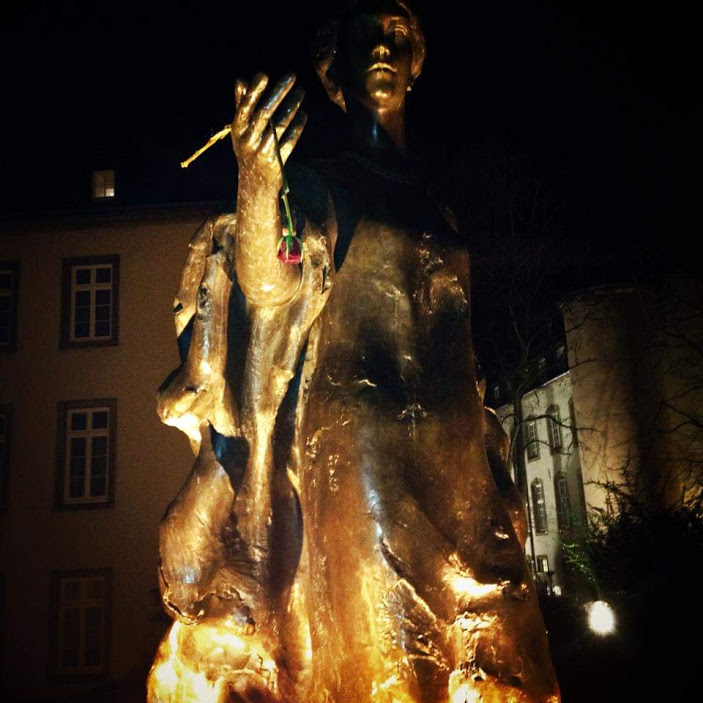
… is hailed for saving the Luxembourgish monarchy. She ruled from 1919 to 1964. In 1940 when Luxembourg was invaded by Germany, she went into exile with her family, rather than cooperating. From her new home in London, she began to broadcast back to her country with the help of the BBC. These broadcasts were used to rally support and explain the situation to those back home. She then went to the US, helped by President Roosevelt, and did what she could to help Luxembourg from afar. On the 10th September 1944, Luxembourg was finally liberated by allied forces, one particular soldier involved in the liberation was Prince Jean, Charlotte’s eldest son. Her statue which stands on Place de Clairefontaine was designed by the French sculptor Jean Cardot.
 In Luxembourg It's Three